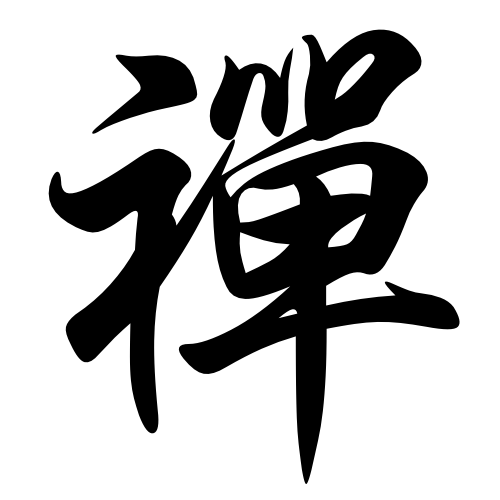
Question: Where does Chán 禪 originate?
Key: In China. It later spread to Vietnam, Mongolia, Korea and Japan. In recent times there has been an expansion with small pockets all over the world.
Details: When Buddhist texts first arrived in China (around the 1st century CE), the core Indian meditative concept of Dhyāna (mental absorption or meditation) was transliterated as Channa 禪那, later abbreviated to Chan 禪. However, early Chinese scholars and seekers, who were deeply steeped in Daoist 道家 traditions, lacked a native framework for Indian Buddhist metaphysics.
To bridge this gap, they employed a method known as Geyi 格義, or “matching the meanings.” Early translators and interpreters thus mapped Buddhist concepts onto familiar Daoist understanding and vocabulary. For instance, Buddhist “emptiness” (śūnyatā) was initially explained using the Daoist concept of Wu 無, (non-being), and the meditative state of Dhyāna was likened to Daoist practices such as Zuowang 坐忘, “sitting in oblivion” or Shouyi 守一, “guarding the One”.
In Short Chán 禪 is a hybrid of Daojia philosophy and Buddhist meditation concepts (a highly simplified explanation though). It evolved in China somewhat by circumstance. It is not Buddhist per se, but Chán 禪 respects the origin of the mind practice.
Chán 禪, when practiced in the oldest form, colloquially known as Mountain Chan, original to around 100 to 200 CE, is a different version to the later, very popular practice of the Tang era (618-917 CE).